


Heating & Cooling with Heat Pumps

Category

Home Energy

Impact

?

Cost

High

Electrifying your home heating and cooling system with a heat pump is one of the most effective ways to heat and cool your house and reduce your overall carbon footprint. An ideal time to consider a heat pump is when you need to replace your existing heating or cooling system or when you want to add air conditioning.

There are several federal and state incentive programs to sweeten the deal (check the Deep Dive Tab for more info). 

In order to qualify for the state MassSave incentives, you must get a MassSave free home energy assessment and add the maximum insulation to your home and significantly reduce drafts. You can get a no-cost Home Energy Assessment through MassSave which can then assist with insulation options.  

There are two types of heat pumps

Air source heat pumps. They can be ductless (also called mini-splits) or use a house’s duct system. 

Ground source heat pumps, also known as geothermal. These are larger than air source systems and can be initially more costly but have a long lifespa and thus can be less expensive in the long term.  

Financial Incentives

Air source heat pumps and mini-splits: 

    • State and Federal Incentives 
    • 30% federal tax credit for equipment and installation costs starting in 2023 with a limit of $2,000 per year. Electrically heated homes are NOT ELIGIBLE. Subject to a $14,000 HEERA cap (includes weatherization and heating equipment). Pair with a 30% federal tax credit for electric system upgrades with a cap of $600. Estimate your savings via this calculator from Rewiring America.
    • 2022 Mass Save incentives are up to $10,000 for a whole home conversion from a non-gas heating system. Or, $1,250 per ton for a partial conversion capped at $10,000. Households may be eligible for enhanced incentives based upon their annual income. Incentives subject to change.
    • How the Mass Save rebates and federal tax credits may be combined remains to be determined.
    • Heat pumps are eligible for a 0% Mass Save Heat Loan
    • Additional information:

Ground source heat pumps (also known as geothermal): 

    • State and Federal Incentives 
    • 30% federal tax credit for equipment and installation costs starting in 2023. Estimate your savings via this calculator from Rewiring America.
    • 2022 Mass Save incentives are up to $15,000 for a whole home conversion from a non-gas heating system. Or, $2,000 per ton for a partial conversion capped at $15,000. Households may be eligible for enhanced incentives based upon their annual income. Incentives subject to change.
    • How the Mass Save rebates and federal tax credits may be combined remains to be determined.
    • Additional Information:

Steps to Take

  1. Attend a Harvard Heat pump meeting (given 2x per year) to learn more about heat pumps and meet heat pump coaches who can help you understand your options, assist you in reviewing vendor recommendations and quotes and educate you on maintenance of systems once installed.  Subscribe to the Harvard Climate Initiative Committee newsletter to keep abreast of upcoming events by emailing harvardmaclimate@gmail.com
  2. If you would like to set up a free personalized consultation with one of our heat pump coaches, fill out this FORM and we’ll get you set up!
  3. Sign up to receive a free MassSave Home Energy Audit (you are entitled to a free audit every three years). MassSave Audit
  4. Contact several qualified installers for an estimate. In 2018, the Town’s Energy Advisory Committee had a grant from the state to run the HeatSmart program.  Two vendors were vetted by the committee as knowledgeable, reasonably priced installers. They can be contacted at:
  5. Explore your rebate and financing options. A good installer should automatically sign you up for any available rebates or savings, but it’s good to be aware of what the options are.
  6. Let us know how it went by leaving a Testimonial under the tab above!

Deep Dive

Heat pumps work much the way your refrigerator does, by circulating a substance called a refrigerant through a cycle of evaporation and condensation. During the heating season, a heat pump moves heat from the outside air to your home. (Since the air outside always contains some heat, a heat pump can supply heat even on cold winter days.) During the summer, a heat pump cools just like an air conditioner, by transferring heat from inside to the outdoors.

AIR SOURCE HEAT PUMPS (ASHP)

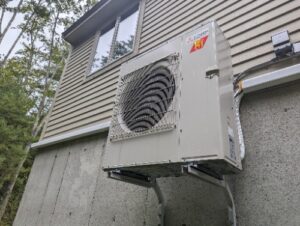
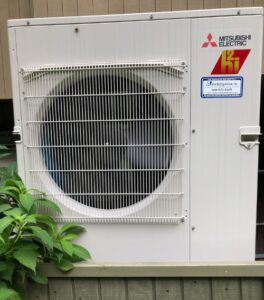
ASHP have two parts: an outdoor condensing unit and one or more indoor air handling units, connected by a conduit through the wall. Some are ductless and some use ducts. Want to see it in animation? Watch the mini-split videos on Mass Save

I heard heat pumps don’t work in New England.

This used to be true, but now effective cold climate heat pumps are available and they work very well in New England. 

Doesn’t it cost more to heat with electricity?

No, because heat pumps move heat rather than generate it, they can heat and cool at a significantly lower cost than other systems. In fact, The  Northeast Energy Efficiency Partnerships found that in the Northeast and Mid-Atlantic regions air source heat pumps save around 3,000 kWh (or $459) when compared to electric resistance heaters, and 6,200 kWh (or $948) when compared to oil systems.  

Do I have to replace my entire existing heating system to use heat pumps? 

Heat pumps work with most heating systems, such as forced hot air, radiators, or radiant (floor) heat. They can also be “ductless,” in which case they transfer warm or cool air directly into the house.  

Types of Air-Source Heat Pumps

The different types of air source heat pumps are described below.

Ductless vs. Ducted vs. Short-Run Ducted

Ductless applications require minimal construction as only a three-inch hole through the wall is required to connect the outdoor condenser and the indoor heads. Ductless systems are often installed in home additions.

Ducted systems simply use ductwork. If your home already has a ventilation system or the home will be a new construction, you might consider this system.

Short-run ducted is traditional large ductwork that only runs through a small section of the house.  Short-run ducted is often complemented by other ductless units for the remainder of the house.

Split vs. Packaged

Most heat pumps are split-systems—that is, they have one coil inside and one outside. Supply and return ducts connect to the indoor central fan.

Packaged systems usually have both coils and the fan outdoors. Heated or cooled air is delivered to the interior from ductwork that passes through a wall or roof.

Multi-Zone vs. Single-Zone

Single-zone systems are designed for a single room with one outdoor condenser matched to one indoor head.  Multi-zone installations can have two or more indoor heads connected to one outdoor condenser. Multi-zone indoor heads vary by size and style and each creates its own “zone” of comfort, allowing you to heat or cool individual rooms, hallways, and open spaces. This distinction may also be referred to as “multi-head vs. single-head” and “multi-port vs. single-port.”

GROUND SOURCE HEAT PUMPS (GSHP)

Although many parts of the country experience seasonal temperature extremes — from scorching heat in the summer to sub-zero cold in the winter—a few feet below the earth’s surface the ground remains at a relatively constant temperature. Depending on latitude, ground temperatures range from 45°F (7°C) to 75°F (21°C). Like a cave, this ground temperature is warmer than the air above it during the winter and cooler than the air in the summer. The GHP takes advantage of this by exchanging heat with the earth through a ground heat exchanger.

Relative to air-source heat pumps, they are quieter, last longer, need little maintenance, and do not depend on the temperature of the outside air.  The installation price of a geothermal system can be several times that of an air-source system of the same heating and cooling capacity, yet the additional costs are returned to you in energy savings in 5 to 10 years. System life is estimated at up to 24 years for the inside components and 50+ years for the ground loop. There is little to no maintenance required of these systems.

Information on how a ground source heat pump works can be found at Department of Energy

What is a closed-loop system?

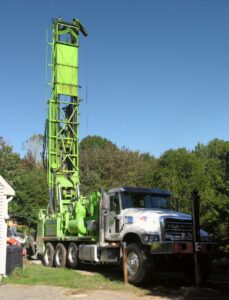
There are 5 types of closed loop systems. All types use a continuous loop where the heat transfer fluid is circulated.  A horizontal loop is usually the most cost effective when adequate yard space is available and trenches are easy to dig. Using trenchers or backhoes digging trenches three to six feet below the ground, a series of parallel plastic pipes are laid. The trench is then back filled. A typical horizontal loop will have 400-600 feet of pipe per ton of heating and cooling capacity. 

Vertical loops are preferred in many installations where yard space is insufficient and where preservation of existing landscaping is desirable. Contractors bore vertical holes in the ground 150-450 feet deep. Each hole contains a single loop of pipe with a U-bend at the bottom. The hole is then backfilled or grouted to improve the thermal conductivity. Each vertical pipe is then connected to a horizontal pipe underground to and from the heat pump. Vertical loops are generally more expensive to install, but require less piping than horizontal loops. 

Do I need to increase the size of my electric service?

Most homes already have adequate electrical service.   

Where is this heat pump installed?

Most are installed in the same place where your oil or gas burner is located.       

How is a heat pump sized?

A qualified contractor will size your heat pump based on an accurate heating and cooling analysis of your home. Factors like the type of windows and insulation R. values are taken into account and a BTU per hour heat loss and heat gain will result. The heat pump is then sized and will keep you warm during the coldest winter night and cool on the hottest summer day.

Testimonials

We installed whole home heat pumps after purchasing our home in 2022, and we absolutely love them! They heat and cool the house so well,…
We love our heat pumps!
Submitted by: Holly Sullivan
We do not hire contractors for house projects easily. So we know that we would not have installed a ducted heat pump without the help…
Couldn’t Have Done This Without Help From Harvard’s Climate Initiative
Submitted by: Kathy Dollard
After 9 years of heating/cooling with Mini-splits, we decided to switch to geothermal heating and cooling. Massachusetts Geothermal was excellent to work with, throughout the…
From Mini-splits to Ground Source Heat Pumps
Submitted by: Amelia Ward
Earlier this year our heating system failed on one of the coldest days!  We met with Dave an amazing energy coach who jumped into action,…
New Heat Pump
Submitted by: Sarah Saleh
In 2018, under the HeatSmart program, we installed a Ground-Source Heat Pump system for heating and cooling.  One unit in the basement, with new ductwork,…
Ground Source Heat Pump
Submitted by: George Snyder
Last winter we installed a heat pump powered air conditioner. The bonus was it also provides supplemental heat, which offsets our oil use a little…
Environmentally Friendly AC
Submitted by: Kim&Jeff Manning
We installed heat pumps a few years ago when we gave in to adding A/C.  For some reason that I can't explain, the quality of…
Heat Pumps climate control
Submitted by: Molly Cutler
My house had heat pumps on one side when I moved in, but they didn't cover the other half. This summer I had the a…
Pretty Cool
Submitted by: John Cushing
I had worked with Wilson Brothers (Pepperell MA) for many years when it came time to replace the central airconditioning unit we had purchased from…
Wilson Brothers – Professional and Creative with Solution
Submitted by: Elizabeth Breed
The fourth year living in our new/old(1781) home we discovered that our window mounted airconditioners would not keep up with the hottest summer days.  After…
Efficient cooling AND heating
Submitted by: arlene genova
This spring we installed units that provide heat as well as air conditioning; Acton Refrigeration has been a great resource and did a wonderful job…
Splits/Heat Pump installations
Submitted by: Emily Harris
Our heat pump was a wonderful addition last fall - for heating, of course (SO nice not to rely on the big tank of oil…
New Heat Pump is Excellent
Submitted by: Kristin Kelley-Muñoz
Just over a year ago I had 3 mini splits (air exchange heat pumps) installed in my colonial-style home:  I upstairs in the master bedroom…
Year One with My Mini Splits.
Submitted by: Lucy Wallace
We replaced our aging oil furnace with a geothermal heat pump system last summer, and it's kept our 18th century house perfectly comfortable through extraordinarily…
Switching to Geothermal Heat Pumps
Submitted by: Eric Welsh
Our gas furnace was in need of replacement. We wanted a heat pump for efficiency and to electrify much of our heating needs. Given the…
Dual Fuel Heat Pump Installation
Submitted by: Steve DiPrizio
We moved into our new house in August of 2014. We built the house, and as we worked with the architect to design it, we…
We Started Our Journey Toward Zero Carbon Emissions Eight Years Ago
Submitted by: Rich Marcello
Had 2 mini splits installed at the end of August 2022, and so far I love them. Even produced heat when it was -15 degrees…
Love my mini splits!
Submitted by: Kit Holland
Over the last few years, we have added several heat pumps, a couple as mini-splits, and the final one using existing ducts that were attached…
No more fossil fuel for heat!
Submitted by: Charles Zucker
We had heat pumps and mini splits installed in March and couldn't be happier. The summer was very comfortable, despite the heat and humidity, and…
New Heat Pumps
Submitted by: Charles Oliver
We finished installing our new geothermal heating and cooling system in late March. With summers getting hotter, we are incredibly grateful to have this efficient…
We love our new geothermal AC
Submitted by: Nancy Hartshorne
We had ground source heatpumps put in under the Heatsmart program back in 2018. You can see the pictures of the big drill that did…
Ground Source Heat Pumps
Submitted by: Ellen Sachs Leicher
Heat pumps were installed in the new COA building by Classic Construction, and paid for by the citizens of the town of Harvard
Heat pumps at new COA building
Submitted by: Debbie Thompson

Add a Testimonial

0%

Subscribe

* indicates required
Email Preferences